The Danteum
An Allucinazione in Rome, Italy
Rome, the eternal city, once shrouded in the shadow of Mussolini’s regime, sprawls before me as I walk its storied streets. My intent was simple: visit the Colosseum. But Rome, ever the city of surprises, had other plans.
Before the ancient amphitheater could come into view, an unexpected sight halted me. An imposing brick masonry wall, ominous and grand, stood sentry. A narrow passage, uninviting and mysterious, led into what seemed a labyrinthine depth.
No signs guided the curious, only a plaque bearing the severe profile of Dante Alighieri. An unspoken challenge lingered in the air. So, with little choice and much curiosity, I stepped across the threshold.
The passage was dark, narrow, and claustrophobic, with walls that seemed to press in and mock my resolve. Was this a mistake? But the die was cast. Emerging from the tunnel, I found myself in a forest—not of trees, but of columns. Thick and oppressive, they formed a grid, allowing sunlight to filter through in a calculated, eerie perfection.
This forest was a strange, modern echo of the one where Dante met Virgil. Here, the light, cold and measured, was more daunting than the gloom. As I navigated this architectural maze, I found a short flight of stairs, another threshold awaiting.
Dante’s “Divine Comedy” was meant to terrify, to invoke the fear of the hereafter. Yet, in Giuseppe Terragni’s architectural vision, Hell was not a place of torment but of awe. The Inferno, dark and enigmatic, used the golden section in its columns. Their abacuses, spiraling with mathematical precision, evoked wonder rather than dread.
Facing a long wall with numerous openings, each leading to a staircase, I pondered my escape. Which path to ascend? A random choice led me to the fifth staircase—a dead end. Panic set in, professionalism discarded. I fled back to the wall, desperation mounting.
Tourists, laughing, made their way to the last opening. No esoteric codes, just simplicity. Following them, I climbed, squinting as I emerged into Purgatory. It was an inversion of Hell, more open, more light, yet still bound by the golden ratio. Columns outnumbered visitors, each a metaphor for the souls trapped here, as my pamphlet suggested.
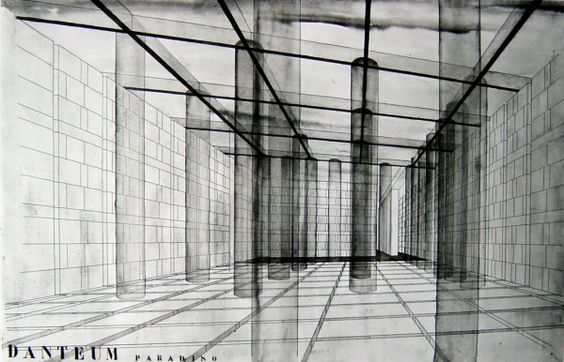
The urge to reach Paradiso grew. I navigated another labyrinth, this one of pseudo walls and columns, only to confront a relief of an eagle. An exit, hidden in a corner, beckoned. Sunlight burst through, blinding and brilliant.
Now, the columns were glass, capturing and scattering the light. It was dazzling, overwhelming, yet the exit was near. I passed through another narrow passage, glimpses of Rome’s ancient grandeur visible through small openings.
Finally outside, I collapsed on the sidewalk, senses overwhelmed. The architecture had left its mark, a blend of poetry and exhaustion. Tourists followed, less affected, their enchantment fleeting. The magic, it seemed, had worn off too soon.
Bibliography
Unwin, Simon. Twenty Five Buildings Every Architect should Understand. New York: Routledge , 2015.
 Radhya Kareem